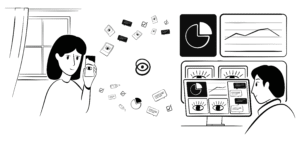



While tele-eyecare is increasingly accepted by Eye Care Professionals (ECP) and their patients, it remains unclear how it compares to an in-person examination. A study comparing traditional in-person and tele-eyecare exams for sixty-six patients found no significant difference in final refraction results or best-corrected visual acuity between the two methods, with ocular health assessments also showing virtual agreement.1 Expectedly, patients and ECPs expressed a statistically significant preference for in-person care regarding satisfaction, trust in accuracy, and ease of communication. The full efficacy of tele-eyecare remains to be assessed, but the clinical alignment suggests that remote examinations offer opportunity for ECPs and their patients.
Key Findings
- Tele-eyecare is becoming increasingly adopted, yet it’s unclear how it compares to in-person examinations.
- A study that compared tele-eyecare to in-person exams found no significant difference between refraction results and eye health assessments, but both ECPs and patients preferred in-person care for satisfaction, trust, and ease of communication.
- The clinical alignment between tele-eyecare and in-person examinations offers opportunity for ECPs and their patients.
Background
Optometry has a steeped and critical history of enhancing the quality of life of eyecare patients by providing them diagnostic and therapeutic eyecare examinations and services. In recent years, consumers have become more eager to receive healthcare services remotely in an effort to gain freedom in their personal lives, ranging from remote mental health services to sleep studies.
At the same time, some providers are increasingly interested in working from home if valid clinical technologies allow. In eyecare, some optometrists are engaged in delivering remote care for patients who are in a clinic somewhere they are not, sometimes to deliver care in underserved areas but in some cases to support a business state that allows one doctor to care for patients at multiple clinic locations.
The question that arises is whether the patient experience and outcome is optimal in these tele-eyecare situations. In January 2024, the New Zealand journal Clinical Optometry published an article called “Comprehensive Primary Eye Care: A Comparison Between an In-Person Eye Exam and a Tele-Eye Care Exam” by Blais, Tousignant, and Hanssens.1 They reviewed the outcomes for sixty-six patients who were passed through both a “gold standard in-person exam” against a tele-eyecare examination delivered via videoconference. Given the increasing acceptance of the remote tele-eyecare examination as seen in the American Optometric Association’s position statement on telehealth published in 2025, Optometrists need to dig into the key learnings from such comparisons.2 With increased patient demand for this care, the only future question is how much this mode of examination delivery will increase.
Study Insights
The patients received two successive examinations from an investigator optometrist at the School of Optometry in the University of Montreal. The examinations followed the clinical guidelines for examination of the American Optometric Association. The in-person exam was performed in an Optometry clinic while the tele-eyecare exam was performed by a remote ECP. An in-person technician supported the tele-eyecare exam by running the patient through a series of tests that required face-to-face interaction while the remote ECP performed the remaining examination including refraction via the DigitalOptometricsTM tele-eyecare system.
Thereafter the patients were surveyed on a variety of satisfaction measures, while the researchers also performed comparative analysis of the exam findings. What was learned?
Prescription
When comparing the trial frame demonstration of the final prescription of each examination, there was no statistical difference in preference for the results of either examination type. And, best-corrected visual acuity had excellent alignment.
Ocular Health Assessment
Analyzing the results for documented findings as well as grading of condition severity demonstrated virtual agreement between the remote and in-person examinations for both anterior and posterior segment assessments. While the remote ECP did not find four minor issues seen in-person, the remote ECP properly documented four mild issues not seen in-person.
Patient and Provider Satisfaction
When assessing the level of trust of exam accuracy, ease of communication, and establishing a trusting relationship, the statistically significant advantage went to in-person care. Furthermore, both patients and ECPs preferred the in-person examination.
Study Summary
The researchers were careful to point out that efficacy of the tele-eyecare examination modality could not be assessed. But based upon the excellent alignments of outcomes and satisfaction, it’s logical for ECPs to consider tele-eyecare remote examinations to be a reasonable path to increase access to eyecare. Still, there are important limitations that need to be addressed in such an implementation, including the level of training and experience of the in-clinic technician who supports the remote ECP.
Editorial Impressions
The researchers referred to the in-person examination as the “gold standard” which is reasonable. By finding the remote examination to be statistically and clinically non-inferior to the refractive component of the examination, the vision correction capabilities delivered by the remote exam could certainly be leveraged to serve those without ease of access to in-clinic care.
Given that the eye health assessments were also similar, tele-eyecare remote examinations might be useful for periodically monitoring patients who have already undergone an in-clinic examination. Broadly speaking, both ECPs and their patients value their relationships but are interested and willing to utilize technology that will bridge their gap and increase the utilization of it to extend their connections.
The researchers acknowledged their relatively small sample size, but that the preference of both patients and ECPs to in-person care should remind us all of the power of doctor-patient direct interactions. Any technology that enables secure conversations about the doctor’s recommendations and patients’ concerns should be embraced.
Looking forward, ECPs should assess the market for reasonable, clinically-accurate remote eyecare systems that assist patients in their care journey. While never losing sight of the criticality for relationship development in-person, tele-eyecare systems could deliver high value to patients and ECPs when offered as an adjunct to periodic in-clinic care.